
How I care for variegated Alocasias and their corms
Growing conditions
Every plant here is grown in my indoor cabinet with warm temperatures, bright light, and elevated humidity. These are the conditions that work in my space—not hard requirements for yours.
Choose what you’re growing below for the notes I follow with my own plants and corms.
A rooted, actively growing Alocasia
Humidity
70–85%
(higher is preferred)
Temperature
72–85°F
(22–29°C)
Lighting
12–14 hours daily
(Barrina T5, bright indirect)
Fertilizer: I use Foliage Focus with most waterings at the recommended dilution while my plants are actively growing.
- Unbox your plant as soon as possible.
- Give it a quick once-over after shipping. Check the leaves, growing point, and roots if they’re visible.
- Give it a few days to settle before making major changes. Unless there’s a reason to intervene, I avoid immediately repotting or changing substrates.
- Keep its moisture level consistent. Moist is good; soggy is not.
A little cosmetic shipping stress can happen. I pay much more attention to how a plant settles in and what its next leaf tells me.
A sealed corm, ready for its next chapter
Humidity
80–95%
(the higher the better)
Temperature
75–85°F
(24–29°C)
Lighting
Bright, indirect
(once a shoot appears)
Growing medium: Damp — not soggy — sphagnum moss, perlite, pon, or your preferred rooting mix. Airflow matters as much as humidity: it is what keeps mould and rot away while the container stays closed.
Keep it warm and very humid
Ideal conditions: 80–95% humidity and 75–85°F (24–29°C).
Plant in the right medium
Use damp (not soggy) sphagnum moss, perlite, pon, or your preferred rooting mix.
Option: corm riser method
See the growing options below for details on this method.
Good airflow is essential
Maintain airflow to prevent mould or rot while keeping humidity high.
Patience pays off
It can take several weeks to months for roots and a new shoot to appear. Every corm grows on its own timeline.
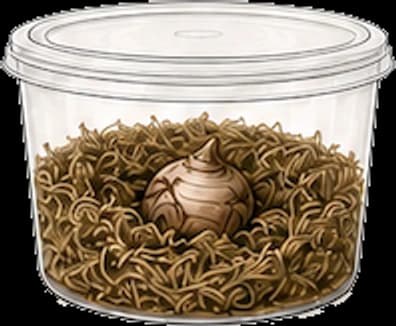
In humid medium
Place the corm in damp (not soggy) moss, perlite, pon, or your preferred mix. Keep the container closed or sealed to maintain high humidity.
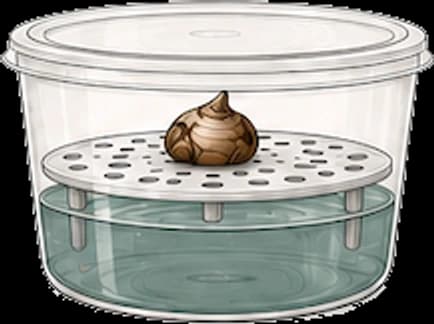
Corm riser method
Place the corm on a riser above the water. Keep the water level just below the platform so the corm stays dry while enjoying very high humidity. Seal the container to maintain high humidity.
- Keep it warm and very humid, and keep the air moving so mould and rot cannot take hold.
- Then wait. Roots and a new shoot can take several weeks to several months to appear.
Every corm grows on its own timeline. Some sprout in weeks and some take months, and neither is a sign that something has gone wrong.